
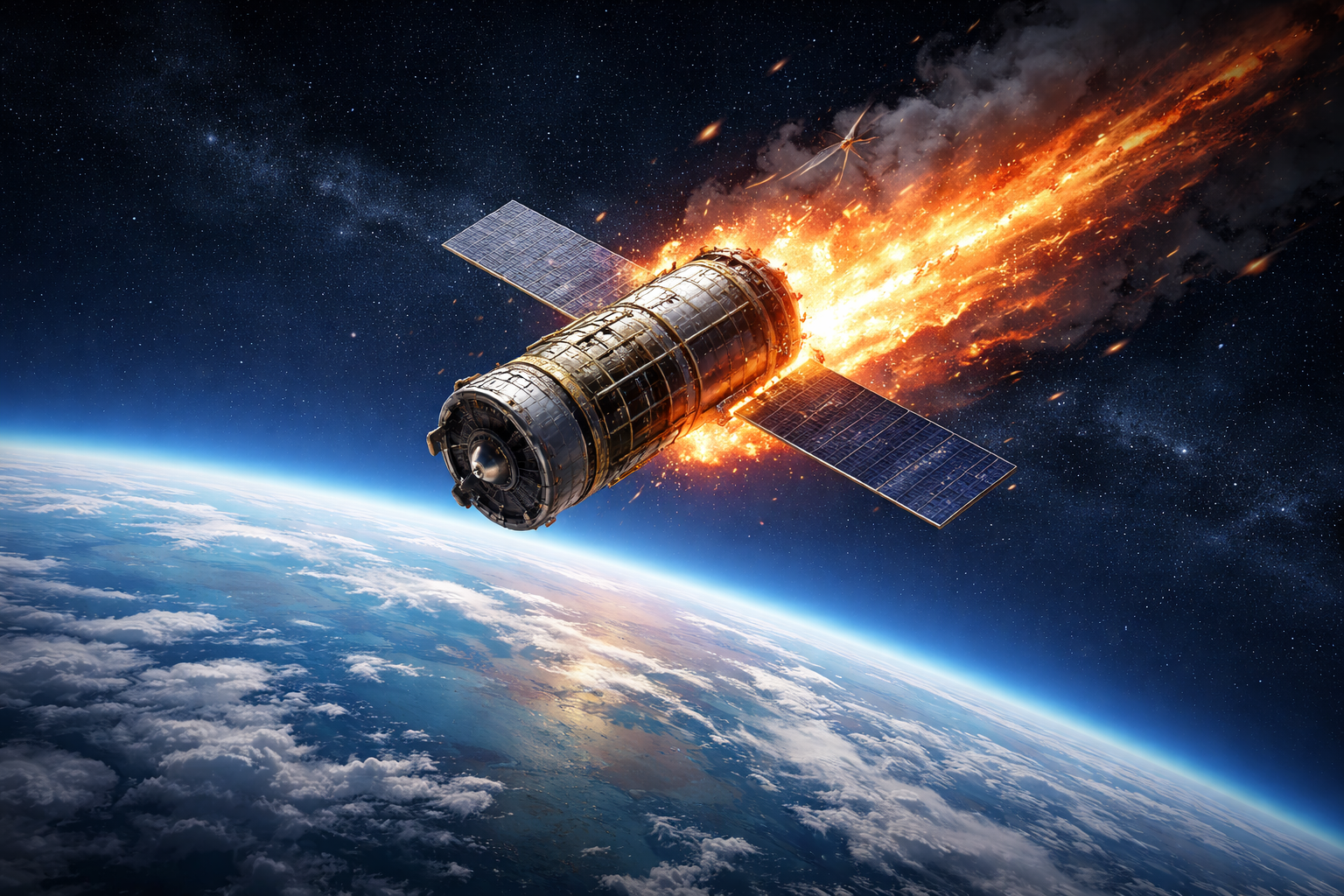

A spacecraft launched by NASA is expected to fall back toward Earth after spending more than a decade orbiting the planet. The satellite, known as Van Allen Probe A, was originally launched in 2012 as part of a scientific mission to study Earth’s radiation belts and the behavior of charged particles in space.
Weighing roughly 1,300 pounds (around 600 kilograms), the probe played an important role in helping scientists understand the powerful radiation zones surrounding Earth. The mission lasted far longer than initially planned and provided valuable scientific data for several years before the spacecraft was finally shut down in 2019 after its fuel supply was exhausted.
Since then, the satellite has gradually lost altitude due to a natural process known as orbital decay. Over time, the thin upper layers of Earth’s atmosphere create drag on satellites in low orbit, slowly pulling them closer to the planet. Scientists expect the spacecraft to re-enter the atmosphere around March 10, where extreme heat generated by friction will likely burn up most of the structure.
Experts say the possibility of debris reaching populated areas is extremely small because most of the satellite will disintegrate during re-entry. Even if a few fragments survive, they are far more likely to land in the oceans, which cover the majority of Earth’s surface.
Events like this are not uncommon, as many old satellites eventually fall back to Earth after completing their missions. However, the situation highlights the growing concern about space debris and the need for better strategies to manage aging spacecraft in orbit.
The return of this long-serving probe marks the final chapter of a mission that helped scientists gain deeper insights into Earth’s space environment and the forces that shape our planet’s protective magnetic shield.


 By
By aplicativo betsul says:
  p3petvip says:

 By
By